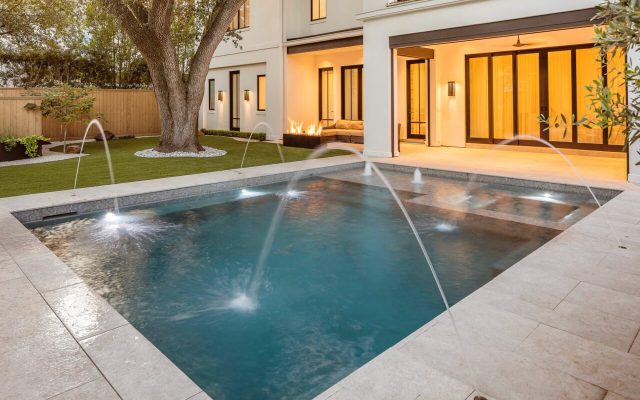
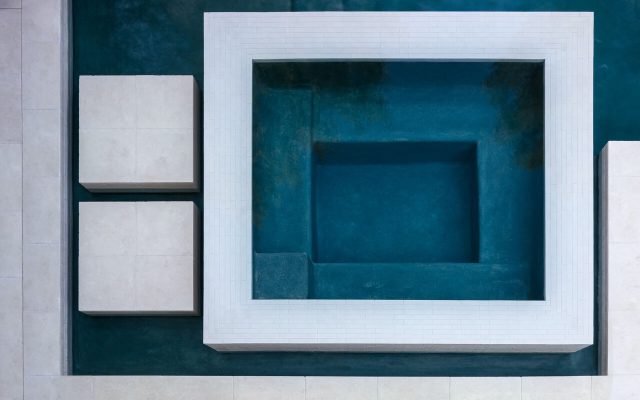
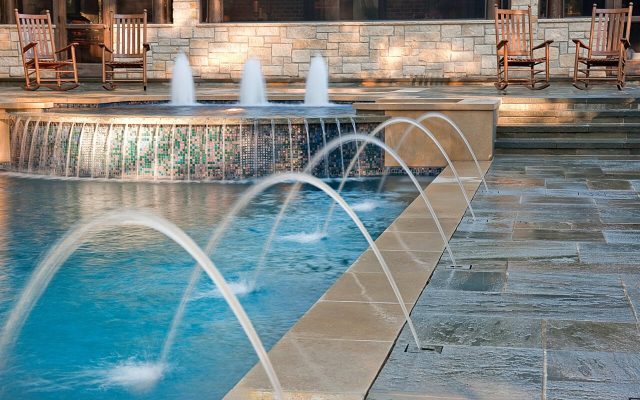
The first thing to consider in landscape pool design is the size and shape of the pool. It must be constructed in the complex of a larger and more comprehensive landscape master plan. Home architecture must be respected above all things. Next, softscape elements and outdoor buildings must appear appropriately complimented by the pool’s appearance. What is my first consideration in landscape pool design?You want to decide on the size and shape of the pool. It is always better to talk to a professional landscape designer about this than the pool contractor. This is because the pool itself is going to fit into the context of a larger landscape master plan. The geometry of the pool must respect the architecture of the home and proportionally compliment the hardscapes and softscape elements of your yard. How large should my pool be?Think about your lifestyle and your plans for future events. If you have children, or if you plan to host parties around the pool, you will need a larger swimming pool than you will if you only plan to use it as a couple or entertain a handful of close friends. Where should I have the pool built?Landscape pool design is all about relationships to other points of interest. You not only want the pool to look good when you look at it from the home, the arbor, the outdoor kitchen, or the morning garden, but you also want these same features to appear unique and clearly visible when you look out into your yard from the vantage point of your swimming pool patio. Should special safety features be included in my landscape pool design?If you have children, yes. If you plan to invite elderly guests or people with disabilities to your home, handrails and special steps that lead down into a shallow part of the pool need to be built into its design.  What recreational features can be incorporated into landscape pool design? One of the most popular features that we often build into our pools is a spa. Spas are normally heated and lit so people can feel a blend of comfort and luxury when reclining within them. Spas can also be designed with special jets that will help those with arthritis or other physical challenges get safe and healthy water exercise. If you have such a physical challenge, get your doctor to describe in detail what you need in terms of water exercise and share it with our design staff. We have all sorts of custom designs we can adapt to your needs. Do you recommend special water features?That is a matter of personal preference, but the decision to incorporate special water features needs to be made at the onset of landscape pool design. Waterfalls add excitement and vertical impact to pools, and when lit with underwater lights, a sense of magic. Water jets can also add drama and impact to both daytime and nighttime pool activities, as well as giving children something to play in. What type of patio should I have built around my swimming pool?You can have anything from decorative concrete to something as elaborate as cut stone that is hand-laid and made to imitate something in the natural world. The shape of your patio should aesthetically compliment both the pool and the surrounding landscape. The size of your patio should reflect your anticipated number of guests for planned outdoor events. Labels: Houston Landscape, Landscape Architects, Pool Design, Pool Remodeling, Pool Renovation, Small Pools, Swimming Pools
 Of the multiple items that work well in a Houston landscape, planting azaleas definitely tops the list. Azaleas provide the heart-stopping beauty that heralds the arrival of spring. At Exterior Worlds, we have long thought that all landscapes benefit from such loveliness. There are thousands of azalea varieties, with blossom colors that run the spectrum from white to red. (However, even the large garden centers will carry only a fraction of that quantity.) Planting azaleas in a butterfly garden design or shade garden design enhance all the other decisions you’ve made for these styles. Azaleas are a great choice for foundation planting, too. Some bushes grow less than 12 inches in height and provide good mid-range filler in a layered bed or serve as a spreading groundcover, while other varieties grow quite tall and tend to spread with age. Planting azaleas is a relatively uncomplicated procedure. They prefer good drainage in a slightly acidic soil with partial shade. We advise starting with the planting soil since heavy clay soil, as is found in Houston, benefits from added fibrous material and sand. We recommend a ratio of 1/3 loam (or soil), 1/3 sand, and 1/3 organic matter. In good soil, the hole should be at least a few inches wider than the rootball and as deep as the rootball. Because of this area’s clay content, we position bushes so that the tops of the rootball are several inches above the ground level. We then mound the recommended soil mixture around the rootball. Lastly, we mulch the newly-planted bushes, being careful not to place mulch up the trunks. The last step is to slowly and thoroughly water.  For an additional way to add color to your landscape, planting annuals is a viable option. Seasonal color complements any blooming bushes and trees and adds freshness to the yards. Pots and containers are perfect for annuals since they help define your garden spaces. Small- to large-sized containers can frame a view, create a pathway, or enclose a garden zone. Masses of blossoms make for garden beds with eye-popping beauty while beds filled with one of this and one of that merely look like a mishmash. When planting azaleas, in general we plant them in groups, to underscore the theory that more is more. At the same time, we are careful to give each plant room to grow. In the spacing of the bushes, we take into account their mature size and shape. As for garden designs, the ones that express unity are more pleasing, an objective we accomplish by choosing only one or two colors, grouping bushes in series of three or five, and by repeating these groupings across your landscape. This repetition achieves continuity, unity and balance. A residential landscape designer from Exterior Worlds can help you make the best choices for the conditions of your particular property. We understand the Houston topography and natural elements and work hard to incorporate the architecture of your space and your personal style. In Houston, your garden landscape practically require azalea bushes. Their colors bewitch us. The names alone are lyrical: Pink Cascade, Serenade, Silver Sword, Marvel. Let them work their magic in your gardens. Labels: Gardening, Houston Azaleas, Houston Landscape
 Foundation planting is a term that started when many homes were pier-and-beam construction and homeowners needed landscaping to hide that visual distraction. It refers to the plantings—usually bushes—that are arranged up close to the house. However, these plantings can be an elegant part of your Houston landscape. Foundation planting doesn’t need to be a grim grouping of bushes hugging the house. As mentioned, bush planting is the most common choice for foundational plantings, but other selections are appropriate—even luscious. For instance, we can create interest in your landscape master plan by incorporating layers into the garden beds, with taller plants along the back and moving forward with shorter and shorter plants down to groundcover. Small, flowering trees also add height and color. In all foundational plantings, we are cognizant of yard drainage, an issue of particular importance with Houston’s terrain and weather. Since you always want water to flow away from the house, one method to consider around the foundation is the raised bed. Your plants will love it because it helps keep their “feet” dry.  At Exterior Worlds, we recommend that the best place to start in planting gardens of any type or location is to plan first. We can choreograph the layout on paper to best determine how much to plant and where. We want to take a thoughtful approach to your landscape design, including foundation planting, that truly enhances your home. The pre-planting planning session is particularly helpful if you use a landscape phasing approach to your landscape design. Landscape phasing lets you add elements over time, sometimes during the course of several years, using incremental steps with the more expensive undertakings spaced out to help manage your cash outlay. When we use landscape phasing, we usually do greenscapes first which allows the most time for plants to develop to their mature shape and size. During the planning process, we are careful to incorporate the architecture of your home. If your home is formal and symmetrical, such as a Federal, Georgian or Colonial Revival, then we employ formal aspects in the landscape design—perhaps neatly trimmed shrubs at the front door. As another example, a contemporary home could benefit from a more organic approach. We always think in terms of plants at their mature size and scale. It is a common mistake of the amateur gardener to forget to take into account a plant’s ultimate size. Making the right choice in this area helps keep pruning to a minimum. We also consider the features of the surrounding area because we want to design foundational plantings that are appropriate for the entire site. These elements include the sidewalks, driveway, streets, adjacent bayous and woodlands, large trees, fences and hedges. Exterior Worlds uses the most current landscape techniques to give your foundation planting the look of a professional landscape. We create luxurious, highly personalized signature designs in which green plantings are unified with the home. From the curb to the front door, your property conveys a warm and welcoming impression. Labels: Gardening, Houston Landscape, Planters
 When planning your Houston landscape, your not-so-secret ingredient is the planting soil. It is the proverbial foundation from which all the glorious plant material—blooming vines, verdant bushes, flowering trees and seasonal color—will spring. In the excitement of dreaming about planting gardens, many people make the mistake of skimping on the unseen items, like planting soil. However, at Exterior Worlds, we have seen that proper site preparation is a sure formula for lasting success. If you are planting azaleas, the condition of your soil is particularly important. These magnificent plants that herald spring in Houston thrive best when the soil is healthy. Good soil prep is also necessary if you are planting roses. Soil is a mixture of rock particles, minerals, organic matter, micro-organisms, oxygen and water. The dirt component is usually one predominant element of sand, silt and clay, with a mixture of the other two. We have a high concentration of clay in Houston, which presents special challenges. Clay soil is rich in the mineral-based elements and nutrients that plants need, but it can easily become compacted, especially with regular use, such as foot or vehicular traffic. Additionally, it can also quickly become waterlogged, which causes air pockets to fill with water and kill off soil organisms. The end result—injury to plant roots.  Exterior Worlds advises adding fibrous material and sand to heavy clay soil. Organic matter, such as leaf composts and pine bark, breaks up the small tight-sticking mineral particles to create larger pore spaces that drain more easily and hold oxygen better. For the best planting soil, we recommend a ratio of 1/3 loam (or soil), 1/3 sand, and 1/3 organic matter. It is also a good idea to avoid working the soil or walking on your garden beds when they are wet, which is another issue with high-content clay planting soil, especially in combination with our Texas coastal weather that is subject to torrential rains. Observing this good practice will decrease the possibility of more soil compaction. You want soil that retains moisture, but doesn’t remain wet. So we encourage our clients with low-lying areas or zones with drainage problems to use raised beds to keep the root systems of their plants from sitting in water for long periods. Also, after the soil is properly prepared, we recommend that new beds lie fallow for a few weeks to allow them time to settle. In addition to good soil prep, the next best bet in dealing with clay soil is mulch installation since mulching keeps the clay soil from forming a crust. Because you really can have too much of a good thing, we are always careful not to apply mulch up the trunks or stalks of plants as it will hinder their health. As one of this region’s premier professional lawn and garden services providers, Exterior Worlds can do the labor-intensive and proper soil preparation as well as the regular application of mulch. You’ll be amazed at the long-term benefits. The journey of 1,000 steps begins with the first one and, with garden beds, that first step is the soil preparation. Your dream landscape garden design is just waiting. Labels: Landscaping Companies, Professional Landscaping Design, Tree Planting
What goal am I trying to achieve in garden landscaping?Garden and landscaping services transform your property into a work of art. Like any work of art, there are key points of interest, unique variations of color, and calculated interplays of light and shadow. This makes your yard look multi-dimensional in its expression of beauty. It also provides you with more opportunities for Houston outdoor living, because the many elements that evolve from garden and landscaping services ultimately become hotspots for entertainment. How important is my lawn in all of this?Your lawn is like a canvas. It serves as the backdrop of your garden and landscaping design and establishes the degree of openness that your back yard or front yard communicates to guests. The more grass in your yard, the more a sense of vastness. The more hardscape and conscious cultivation of softscape elements, the more isolated points of interests become. How many gardens should we have in a big yard?It is not the number of gardens, but rather the way in which they are designed and arranged. When we work in a big lawn, we divide it into zones where different garden and landscaping designs can be developed.  There can be a garden pergola in one zone that leads up to an arbor, while in another zone, a hand-laid stone patio can overlook a lighted natural swimming pool nestled beneath forest-like trees. In still a third zone, a swimming pool with flagstone patio and lounge furniture can function as a transition area between the house and the rest of the back yard, while in a fourth zone, a small garden courtyard can surround a lighted custom fountain for special gatherings and conversations under the stars. If my lot is very small, does that mean I can only have one garden in the back yard?No. We also have garden and landscaping designs that work to make a smaller property look much bigger than it is. The key here is to use smaller hardscapes and smaller physical garden sizes to emphasize the grassy parts of the lawn. In places where shade trees may have killed patches of grass, we can plant shade resistant grass and flowering plant species to extend the greenery up to the bases of the trees. This goes a long way toward enlarging the perceived size of the property. Can you plant trees near my gardens?Yes, but only if we plan your garden with shade-resistant species. On a larger lot, you can have a veritable forest of large trees toward the back of your yard and still have plenty of room left over for formal garden and landscaping work. In smaller yards, you have to be choose between limited your softscape options to shade-resistant plants or planting a few trees in key locations where they will not interfere with garden growth. You may also want to consider smaller tree species like Japanese Yew or Japanese maple. Labels: Garden Services, Gardening, Home Landscape Design, Houston Landscape
 A family named Pesek decided that their swimming pool had too much of a “1970s look.” They wanted an entirely new swimming pool designed for them, and they wanted an outdoor room built that would allow them to enjoy a view of the surrounding Houston landscape. After carefully surveying their yard, we recommended a design based on classical geometry and proportional right angles. This would add a touch of elegance that would uphold the conservative design of the home and distinguish the property as a unique keynote in Houston landscaping design. The house itself spoke of a simpler, more absolutist time in history. The fixed constants of the 1950s were clearly evidence in its architectural motifs, which provided us with a template of linearity and deliberate movement true to Classical design principles. We began by rebuilding the swimming pool near the rear entrance of the house. We completely abandoned the original lagoon-pool design. Not only did had it clashed from the beginning with the architecture of the home, but it looked cliché, to say the least, in relation to the greater Houston landscape in general.  The new swimming pool was built as a perfect rectangle distinguished with an innovative type of coping that raised perpendicular to the stone patio surface. We used the natural surface of the Houston landscape to create another perpendicular right angle at the end of the pool, where we installed a waterfall that spilled into a heated spa. The spa was built with something of an optical illusion in mind. Though the water came from within the spa itself, it appeared to be coming from within the pool. This generated a new sense of visual “ebb and flow” that causes the earth to appears to rise up first into an illuminated pool, then onward into the steps of the home. We built an outdoor room at the end of the pool opposite the home. We followed the same principles of simple conservatism and right angles that distinguished the home and the pool. This is not to say that we abandoned modernity by any means. Within the conservative linearity of its framework we created a fully functional outdoor kitchen complete with a smoker, a refrigerator, an ice maker, and a water heater There was even special seating with a flat-screen plasma TV that provided state of the art fun for adults and children alike. When we were finished, there was never any need for the Peseks to return to the house once the party begins. Every amenity is available in a simple, yet also very sophisticated outdoor building. Pure luxury and a serene view of the Houston landscape are just a few steps away in a luxury pool and spa. Labels: Luxury Pools, Pool Design, Pool Remodeling, Pool Restoration, Small Pools
What is a contemporary garden fountain?By definition, it is a custom water feature characterized by stark geometry, superior construction materials, and mechanical sophistication. They operate on remote, silent pumps that circulate water silently so that all you hear is the water itself. Contemporary water fountains are highly customized to fit the unique parameters of an individual residence. Designs are based on linear forms and radial arcs. Decorative flair is deliberately minimized out of an eclectic passion for the abstract. Does the presence of a contemporary garden fountain add any curb appeal to my landscape? Yes. If you have a fountain like this build in the front of your yard, it will draw the viewer’s gaze directly in line with your front door. If you add a fountain to a backyard landscape, it will suggest a sense of outdoor living to prospective buyers. What functional contributions can a contemporary garden fountain do for my yard?One thing it will definitely do for you is drown out the sounds of the city with the peaceful sounds of running water. Contemporary landscape design is all about Mentalism. Adding an island of tranquility to the challenging geometry of the landscape is an excellent way to balance sense and sensibility throughout your yard.  A contemporary garden fountain is often built as the centerpiece in a courtyard garden of some sort. When lit with underwater lights, it can illuminate the immediate seating area around the fountain and serve as a focal point for conversation. What aesthetic contribution does a contemporary garden fountain make to the landscape?For one thing, it adds a very unique and dynamic form of vertical impact to a contemporary garden. Water suggests the essence of life but is non-organic in its own right. Its lack of form is ideal for a landscape shaped by abstract conceptual that challenge the comfort zone of the five senses. However, since water is the foundation of life itself it paradoxically works to soften a contemporary landscape just enough to make it appealing. What materials are used to construct contemporary garden fountains?Any material that catches the eye and provides a stable structure will work, really. Cut, finished stone is a favorite among many contemporary Houston homeowners. Resin and fiberglass also make excellent building materials for smaller fountains used to decorate small courtyard gardens or private patio gardens. This is done to emulate stone or concrete in an environment that cannot support a great deal of weight. Another very popular construction method is to blend either copper or steel with some kind of stone. The combinations of texture and color that result from such blends are nearly infinite. How large are these fountains?They can range in size from very small, simple structures surrounding by a few stepping stones and boxwoods to sizes large enough for children to play in. Contemporary design is one of our favorite styles of landscaping, period; because it is so subjective by nature that customization is never a problem. Whatever you want your fountain to look like, we can build it to order, and we can make it work with your landscape master plan either as the central hub of attraction and outdoor living, or as a supportive, minor element in a more complex and grand design. Labels: Contemporary Landscape Design, Modern Garden Design, Modern landscape Design, Water Fountains, Waterfalls
|
|

Subscribe to Posts [Atom]
|
|